


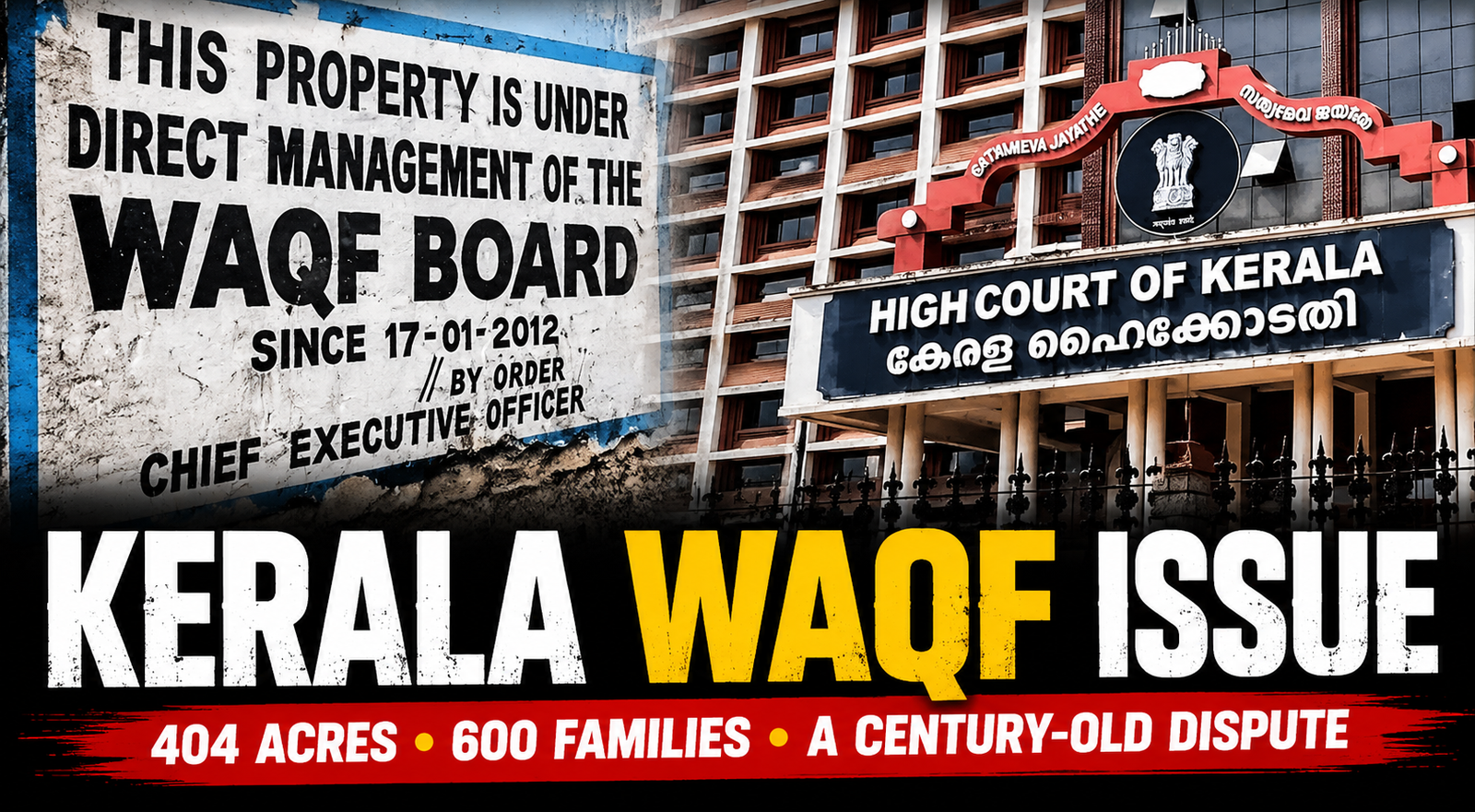
A coastal village near Kochi has become the latest flashpoint in India’s ongoing debate over Waqf properties, after the Kerala State Waqf Board registered 404.76 acres of disputed land in Munambam on the central government’s UMEED portal.
The move has triggered concern among more than 600 Latin Christian fishing families who have lived on the land for decades and now fear uncertainty over their property rights.
Residents allege that the registration has affected their ability to sell property, obtain bank loans, transfer ownership, or invest in their homes. Many families claim that land values have declined while financial institutions have become reluctant to process transactions involving the disputed properties.
The Waqf Board, however, maintains that its claim is based on historical records and legal documentation. The matter remains under judicial consideration.
Table of Contents
ToggleWhat Is Waqf?
A Waqf is a permanent charitable endowment recognized under Islamic law, in which property is dedicated for religious, educational, or social welfare purposes. Once designated as Waqf, the property is generally considered irrevocable and is managed by Waqf authorities for the intended charitable objectives.
The earliest recorded Waqf in the Indian subcontinent dates back to the late 12th century during the rule of Sultan Muizuddin Muhammad Ghori, when villages were reportedly dedicated to support religious institutions. Over subsequent centuries, the system expanded under the Delhi Sultanate and later under the Mughal Empire.
However, the modern legal framework governing Waqf properties was established much later. During British rule, the administration enacted the Mussalman Wakf Validating Act of 1913 and the Mussalman Wakf Act of 1923 to regulate such endowments. Following Independence, the Indian Parliament formally created the present institutional framework through the Waqf Act of 1954, which established State Waqf Boards to manage and oversee Waqf properties. The law was subsequently replaced by the Waqf Act, 1995, and has undergone further amendments over the years.
According to official estimates, Waqf Boards collectively oversee hundreds of thousands of properties across the country, including mosques, graveyards, educational institutions, commercial establishments, and agricultural land.
The Mughal Connection
A significant portion of India’s historical Waqf estate traces its origins to the Mughal era. Mughal emperors frequently dedicated land and revenue streams to support mosques, shrines, educational institutions, public welfare projects, and charitable activities.
One of the most cited examples is the endowment associated with the Taj Mahal, where historical records indicate that revenue from surrounding villages was earmarked for the monument’s maintenance and religious functions. Similarly, major structures such as the Jama Masjid and numerous Sufi shrines were supported through Waqf endowments.
Historians also note that Mughal rulers occasionally made grants to Hindu temples, scholars, and religious institutions through separate royal land-grant systems.
Today, Waqf Boards across India oversee or claim thousands of properties whose origins can be traced to medieval and Mughal-era endowments. Supporters view these properties as protected charitable assets, while critics argue that historical claims sometimes conflict with modern ownership records, creating complex legal disputes such as the one currently unfolding in Munambam.
Why Is Waqf Controversial?
The primary controversy surrounding Waqf properties often involves ownership disputes.
Critics argue that individuals, families, local governments, and religious institutions sometimes discover that land occupied for generations has been recorded as Waqf property based on historical claims or archival records. In such situations, lengthy legal battles frequently follow as courts are asked to determine ownership.
Supporters of the Waqf system contend that many Waqf properties have historically been encroached upon, illegally occupied, or transferred without authorization, making legal protection necessary to preserve charitable assets intended for community welfare.
The debate therefore centers on balancing historical religious endowments with modern property rights and legal ownership records.
The Legal Basis of the Waqf Claim in Munambam
The Kerala State Waqf Board’s claim over the 404.76 acres in Munambam is rooted in a series of historical documents, court rulings, and administrative findings spanning more than a century.
The 1902 Travancore Lease
The earliest document linked to the dispute dates back to 1902, when the princely state of Travancore reportedly leased approximately 404 acres of coastal land in Munambam to Abdul Sattar Haji Moosa Sait, a merchant from the Kutchi Memon community.
The nature of this transaction has become a key point of contention. Legal experts note that if the land was merely leased by the Travancore government rather than privately owned, questions could arise regarding whether it could later be permanently dedicated as a religious endowment.
The 1950 Deed to Farook College
The Waqf Board’s strongest claim stems from a deed registered on November 1, 1950 (Document No. 2115/1950), under which Mohammed Siddique Sait, a legal heir of the original holder, transferred the land to Farook College.
According to the Board, the deed dedicated the property for educational and charitable purposes, with revenues intended to support the education of underprivileged students. Under traditional Islamic law, such a dedication may constitute a Waqf, making the property permanently reserved for charitable purposes.
However, the deed also contains a significant clause stating that if Farook College ceases to exist, ownership would revert to the descendants of the Sait family. Critics argue that such a reversion clause is inconsistent with the concept of an absolute and irrevocable Waqf.
Court Rulings Supporting the Claim
The Board also relies on a long legal history involving ownership disputes.
In 1967, a civil suit was filed before the Paravur Sub Court concerning tenants and Farook College’s authority over the property. The court ruled in favor of Farook College in 1971, recognizing the land’s Waqf status. The judgment was later upheld by a Division Bench of the Kerala High Court in 1975.
The Waqf Board argues that these decisions provide judicial support for its claim that the property constitutes Waqf land.
The Nissar Commission Report
The controversy resurfaced after large portions of the land were sold over several decades to local residents, many of whom possess registered title deeds and have paid taxes on their properties for years.
In 2009, the Kerala government appointed the Nissar Commission to examine issues related to Waqf administration and property management.
The commission reportedly concluded that the 1950 deed amounted to an absolute Waqf and that Farook College lacked the authority to transfer ownership of the land without approval from the Waqf Board. The findings later contributed to the Board’s decision to enter the entire 404-acre tract into the official Waqf Register through suo motu proceedings in 2019.
The Counter-Arguments
Residents, legal experts, and even Farook College have challenged the Board’s interpretation.
Opponents of the Waqf claim argue that the 1950 document was not an irrevocable religious dedication but rather a conditional gift deed (Istadanam) intended to provide financial support to an educational institution.
The Kerala High Court has also examined aspects of the deed’s conditional nature, particularly the clause allowing the property to revert to the Sait family under certain circumstances.
Notably, the management of Farook College itself has publicly opposed the Waqf Board’s position, maintaining that the land was transferred for institutional purposes and should not automatically be treated as a conventional Waqf property.
As a result, the dispute has evolved into a complex legal battle involving historical deeds, religious endowment law, property rights, and the claims of hundreds of families who have lived on the land for decades.
Other Major Waqf Disputes in India
The Munambam dispute is not the first controversy involving Waqf land.
In recent years, disputes involving Waqf claims have emerged in several states, including:
- Tamil Nadu, where villagers in Tiruchirappalli district challenged claims involving agricultural land and property records.
- Karnataka, where allegations regarding Waqf entries in land records became a major political issue.
- Bihar and Uttar Pradesh, where ownership disputes involving religious and private land have periodically reached courts.
- Several urban centers, including Hyderabad and Bengaluru, where competing claims over valuable commercial land have resulted in prolonged litigation.
In most cases, courts ultimately determine ownership after examining historical records, land deeds, revenue documents, and statutory provisions.
Human Impact in Munambam
For residents of Munambam, however, the issue extends beyond legal arguments.
Fishing families who have occupied the land for generations say they now face uncertainty over homes, inheritance rights, and future financial planning. Many fear that ongoing litigation could continue for years, leaving an entire community caught between competing legal claims.
As political parties, religious organizations, and legal experts continue to debate the issue, the final resolution is likely to depend on court rulings and the interpretation of historical ownership records.
Until then, Munambam remains at the center of one of Kerala’s most closely watched property disputes, reflecting a broader national debate over Waqf administration, land rights, and the intersection of history, religion, and modern law.
The ownership claims remain disputed, and the matter is currently subject to legal proceedings.