

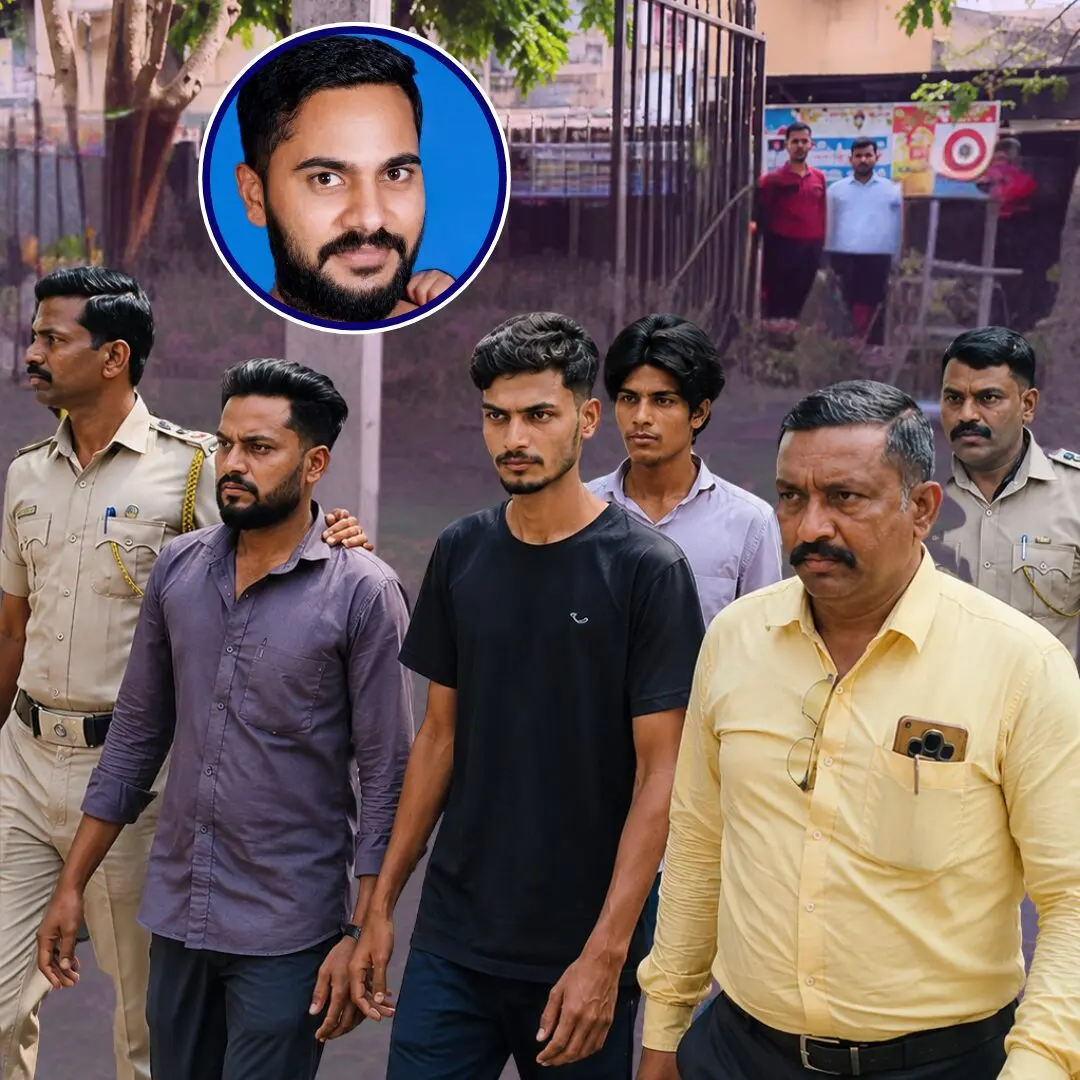
Police in Maharashtra have arrested a muslim man identified as Imran Sheikh along with two of his brothers after a 27-year-old Hindu woman accused him of concealing his identity, marrying her under false pretenses, and later pressuring her to convert to Islam.
According to the official police complaint, the accused allegedly introduced himself as “Vijay” when he met the woman in 2019 while working at a local garage. The complainant stated that she was unaware of his real identity during the relationship.
Identity Allegedly Revealed in Bihar Village
The woman alleged that Imran later took her to his native village, Sultanpur, located in the Bhagalpur district of Bihar. According to her complaint, it was there that he allegedly disclosed his real identity as Imran Sheikh.
She further claimed that marriage rituals were subsequently conducted according to Muslim customs after arriving at the family residence in the village.
Allegations of Pressure After Marriage
The complainant alleged that following the marriage, she faced pressure to adopt Islamic traditions and practices. In her statement to police, she claimed she was pressured to wear a burqa and consume beef despite her religious beliefs.
She also accused members of the accused’s family of harassment and coercion connected to religious conversion.
Some online discussions surrounding the case also referenced a narration from Jami` at-Tirmidhi attributed to Prophet Muhammad, which states:
“It is not lawful to lie except in three cases: Something the man tells his wife to please her, to lie during war, and to lie in order to bring peace between the people.” — Jami` at-Tirmidhi 1939
Police Investigation Underway
The Central Police Station in Ulhasnagar has registered a case against seven individuals in connection with the allegations. Authorities confirmed the arrest of Imran Sheikh and two of his relatives, while further investigation remains ongoing.
Police officials said statements are being recorded and evidence is being examined. No court verdict has yet been delivered, and the allegations remain under investigation.
Wider Debate Around “Love Jihad”
The incident has once again brought attention to the debate surrounding “Love Jihad,” a term used in India and internationally to describe alleged cases in which non-Muslim women are reportedly targeted through romantic relationships, marriage, concealment of identity, or emotional pressure with the objective of religious conversion.
The phrase has been referenced by various activists, researchers, commentators, and organizations across different countries, including groups in the United Kingdom that have raised concerns over similar allegations involving grooming, coercion, or religious manipulation in relationships.
Supporters of the term argue that certain cases follow recurring patterns involving identity concealment and pressure for conversion, while critics contend that the phrase is politically sensitive and should not be used to generalize entire communities.
The current case in Ulhasnagar is under police investigation, and authorities are examining allegations related to identity concealment, marriage, and alleged coercion after the relationship.
There is no official government or National Crime Records Bureau data category that specifically tracks crimes under the term “Love Jihad,” as it is not formally defined as a standalone criminal offense under the Indian Penal Code. However, allegations involving identity concealment, fraudulent interfaith marriages, coercion, and forced religious conversion are often investigated under state-level anti-conversion laws enacted by various Indian states.
Uttar Pradesh
Uttar Pradesh is widely regarded as the focal point of such cases and became the first state to introduce a dedicated law — the Prohibition of Unlawful Conversion of Religion Act — in 2020. The state regularly reports a high number of FIRs and arrests linked to allegations involving fraudulent interfaith relationships and religious conversion. Districts such as Bareilly, Kanpur, Lucknow, and Meerut frequently witness such complaints.
Madhya Pradesh
Madhya Pradesh enacted the Freedom of Religion Act with stringent punishment provisions. The state records a substantial number of cases annually under anti-conversion provisions, supported by active enforcement and legal monitoring.
Gujarat
Gujarat amended its Freedom of Religion Act to specifically criminalize religious conversion through marriage or promises of marriage. Urban centers such as Ahmedabad and Vadodara have witnessed multiple family-led complaints involving interfaith unions and alleged identity concealment.
Uttarakhand and Himachal Pradesh
Both Uttarakhand and Himachal Pradesh have enacted strict anti-conversion laws. Uttarakhand, in particular, classified forced religious conversion as a non-bailable offense with severe prison terms, leading to increased legal cases and public protests in areas such as Purola.
Kerala and Karnataka: Origins of the Debate
While northern states currently account for a large share of active legal cases, the public debate around “Love Jihad” first gained national prominence in Kerala and Karnataka around 2009–2010.
In Kerala, concerns were initially raised by Christian and Hindu community groups regarding alleged patterns of conversion through relationships. Subsequent investigations by agencies including the National Investigation Agency and statements from state police officials stated that no conclusive evidence of a large-scale organized conspiracy had been officially established.
Karnataka later enacted its own Right to Freedom of Religion law and continues to witness legal disputes involving objections to interfaith marriages and alleged coercive conversion practices.